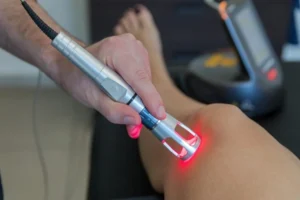
If you’ve been dealing with a nagging ache below the kneecap that flares up on stairs, after runs, or the morning after a hard workout, you’ve probably already tried rest, ice, stretching, and maybe a brace. When those basics stop moving the needle, patients start asking us about shockwave therapy for knee pain, and it’s a fair question to ask. Here’s how we think about it in our Cumming, GA office, who tends to benefit, and how it stacks up against a cortisone shot.
What shockwave therapy actually is
Shockwave (sometimes called extracorporeal shockwave therapy, or ESWT) uses focused acoustic pressure waves delivered through a handheld applicator. The waves pass into the tendon or soft tissue and create a controlled mechanical stimulus. That stimulus appears to nudge the body’s own repair signals: better local blood flow, changes in how pain receptors behave, and a stir-up of the healing process in tissue that has gone quiet and chronic.
It’s not electrical stimulation, and it’s not ultrasound. If you’ve had either of those, this feels different. Patients often describe it as a rapid tapping or thumping sensation, sometimes tender over the sorest spot, but manageable.
The knee conditions that respond best
Patellar tendinitis (jumper’s knee)
Pain right at the bottom edge of the kneecap, worse with jumping, squatting, or deep knee bends, is the classic patellar tendinopathy pattern. We see it in basketball and volleyball players, CrossFit athletes, and weekend warriors from around Forsyth County. When the tendon has become chronic and thickened, it often stops responding to stretching and simple rest. That’s exactly the setup where shockwave tends to earn its keep.
Runner’s knee
“Runner’s knee” is a catch-all term, usually pointing to patellofemoral pain or IT band irritation near the outer knee. Shockwave can help calm down the surrounding soft tissue and trigger points that keep pulling the kneecap out of its happy track. It works best when we pair it with gait work, hip strengthening, and a look at your running mechanics, not as a standalone fix.
Chronic knee pain that won’t quit
Some patients come in with knee pain that’s been hanging around for six months or longer, with imaging that shows tendon changes or mild-to-moderate arthritic wear. Shockwave isn’t going to regrow cartilage, and we’re careful not to oversell it. What it can do is quiet down the soft-tissue pain generators around the joint so you can actually do your rehab and get back to walking, hiking, and playing with the kids without wincing.
Who’s a good candidate for shockwave therapy for knee pain
In our experience, the people who do best share a few things in common:
- Their pain has been present for more than six to eight weeks.
- Basic care (relative rest, activity modification, targeted exercise) has plateaued.
- The main pain generator is a tendon or soft tissue, not a torn meniscus or advanced bone-on-bone arthritis.
- They’re willing to keep doing their rehab exercises alongside the treatments.
Shockwave isn’t appropriate for everyone. We steer away from it over active infections, certain blood-clotting conditions, over growth plates in young kids, and during pregnancy in the treatment area. If you’ve had a recent cortisone injection at the site, we usually wait several weeks before starting. That’s a conversation we have during your exam, not a checklist you have to figure out on your own.
What to expect at a session
A typical visit runs about 15 to 20 minutes. We locate the tender area, apply a coupling gel, and move the applicator over the tendon and surrounding tissue. Intensity is dialed in based on what you can tolerate. Most people describe it as uncomfortable but not painful, and the sensation settles quickly once the applicator lifts off.
Plans usually run three to six weekly sessions. Some patients feel a difference after the second or third visit; others notice the biggest change a few weeks after the series ends, because the tissue is still remodeling. Mild soreness for a day or two afterward is normal and actually part of how the treatment works. We ask you to keep moving, avoid anti-inflammatory medications when possible during the treatment window (so we don’t blunt the healing response), and stick with your home exercises.
How it compares to cortisone or other injections
Cortisone can knock down pain quickly, and there are times it’s the right tool. The trade-off is that repeated steroid injections into or around tendons can weaken the tissue over time, and the pain relief is often temporary because the underlying tendon problem hasn’t changed.
Shockwave takes a different angle. Instead of suppressing inflammation, it prompts the tissue to remodel. Relief tends to build gradually rather than arriving overnight, but when it lands, it often lasts longer because you’ve addressed the tendon itself. It’s also non-invasive, with no needles, no numbing agents, and no downtime.
PRP (platelet-rich plasma) and hyaluronic acid injections are in a different category and can be worth considering for certain joint problems. Those are conversations to have with an orthopedist. In our office, we often see the best outcomes when shockwave is combined with chiropractic adjustments, soft-tissue work, and a focused rehab plan that addresses hip strength, ankle mobility, and how you load the knee day to day.
How we decide together
Before recommending shockwave, we do a proper exam: your history, how the pain behaves, orthopedic testing, a look at how you walk and squat, and a review of any imaging you’ve had. If shockwave fits, we’ll say so. If we think you need a different route, whether that’s an orthopedic referral, imaging, or a different conservative approach, we’ll tell you that too.
This article is educational and isn’t a substitute for individualized medical advice. Please talk with a qualified provider about your specific situation before starting any new treatment.
Come see us in Cumming
If your knee has been the reason you’re skipping runs, avoiding the stairs, or sitting out family hikes, we’d be glad to take a look. Give McNamara Chiropractic a call or book online, and ask about our new-patient options when you schedule. We’ll give you a straight answer about whether shockwave, or something else in our toolbox, makes sense for your knee.